Exploring Malda: A Historical and Political Overview
Introduction to Malda District
The Ganges River makes its initial entry into West Bengal near Manikchak in Malda. Surrounded by the waters of the Ganges, Mahananda, Fulhar, and Kalindi rivers, Malda was once the capital of West Bengal in ancient times, gaining prominence during the eras of Gaur and Pandua. Today, this district is referred to as the gateway to North Bengal, as it serves as a crucial junction for traveling from South Bengal to Siliguri. It is bordered by the districts of Murshidabad, North Dinajpur, and South Dinajpur, with English Bazaar serving as its administrative headquarters. Additionally, Malda shares a border of approximately 165 kilometers with Bangladesh.
Economic and Cultural Significance
Malda is recognized for its political, historical, strategic, and economic importance. The district is well-known across the country for the cultivation of common silk and jute. The famous Fazli mangoes from this region are celebrated worldwide. Following Murshidabad, Malda has the second-largest Muslim population in Bengal. Notably, A.B. Ghani Khan Chowdhury, a prominent Congress leader and former Union Minister, hailed from this district.
Historical Trade Center Established by the British
Once the capital of the Bengal Sultanate, Malda still retains many historical remnants. During British rule, the area saw significant growth in trade and industry, leading to the establishment of a commercial hub known as English Bazaar. The region became a major center for trade and transport along the banks of the Mahananda River, with the Ganges and Kalindi rivers also flowing through it, contributing to its fertile landscape.
District Overview
Area – Approximately 3,733 square kilometers
Population – Approximately 3.98 million
Literacy Rate – Approximately 62%
Lok Sabha Seats – 2
Assembly Seats – 12
Major Cities – Malda, English Bazaar, Chanchal
Administrative Structure
According to the Malda District Council's website, the district was formed in 1813 by merging parts of Purnia, Dinajpur, and Rajshahi. Currently, it comprises two subdivisions: Chanchal and Malda Sadar, with six blocks in Chanchal and nine in Malda Sadar. The district also includes two municipalities: English Bazaar and Old Malda.
Political Landscape
Malda district is represented by two Lok Sabha seats: Malda North and Malda South. Additionally, it has seven assembly seats, including Habibpur (ST), Malda, English Bazaar, Manikchak, Mathabari, Sujapur, and Baishnabnagar.
Demographic Composition
As per the 2011 census, the district's population was around 4 million, making it the second district in Bengal with the highest Muslim population after Murshidabad. Approximately 51.27% of the residents are Muslim, while 47.99% are Hindu, with 0.74% adhering to other religions. Bengali is the predominant language spoken, with minority languages including Khotta, Santhali, Maithili, and Hindi. The population comprises about 21% Scheduled Castes and approximately 8% Scheduled Tribes.
Political History
Before 2009, the Congress and CPI(M) dominated the Lok Sabha seat in Malda. From 1980 to 2004, Congress consistently won this seat. Following the division of the seat into Malda North and Malda South, Congress maintained its hold on Malda South from 2009 to 2019, while Malda North saw victories for Congress in 2009 and 2014, and for BJP in 2019 and 2024.
Assembly Elections and Shifts in Power
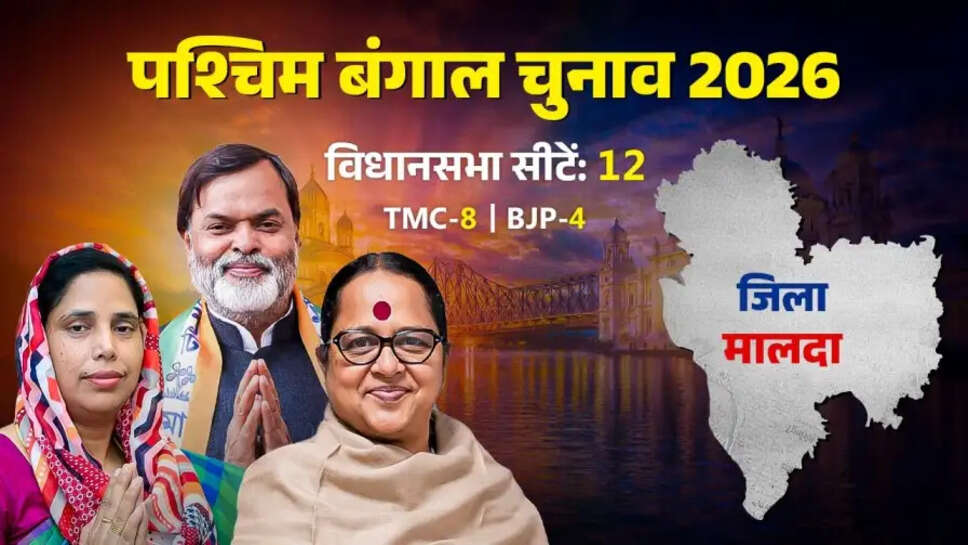
Malda district has a total of 12 assembly seats, including Habibpur, Gajol, Chanchal, Harishchandrapur, Maltipur, Ratua, Manikchak, Malda, English Bazaar, Mathabari, Sujapur, and Baishnabnagar. Until 2011, Congress had a strong presence in most of these seats, winning seven out of twelve in that year, while TMC and Left parties secured three and two seats, respectively.
The 2016 assembly elections marked a shift in the political landscape, with Congress and TMC each winning five seats, while BJP claimed its first seat in the district, and the Left party's influence dwindled to just one seat.
2021 Elections and Future Outlook
The 2021 assembly elections brought significant changes, with TMC winning eight out of twelve seats in Malda, while BJP secured four. Notably, Congress and the Left failed to win any seats, marking a dramatic decline for Congress in a district it once dominated. The upcoming 2026 assembly elections are expected to see a fierce contest primarily between BJP and TMC for most seats.