Independent Candidate Pranab Doley Challenges Money Power in Assam Elections
A New Approach to Assam's Electoral Politics
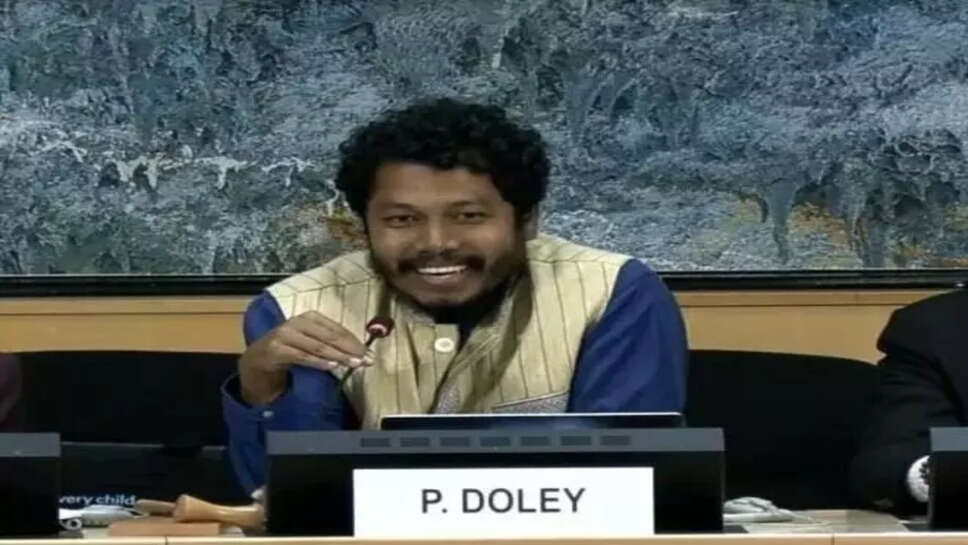
File image of independent candidate Pranab Doley
Guwahati, April 2: The influence of wealth in Assam's electoral scene is becoming more pronounced, with nearly 39% of the 722 candidates for the 2026 Assembly elections identified as crorepatis, as reported by the Association for Democratic Reforms (ADR).
This figure has risen significantly from 28% in 2021, indicating an increasing financial clout among candidates. In this context, independent candidate Pranab Doley from Bokakhat is striving to take a different path, focusing on community engagement rather than financial resources.
Doley, who finished second in the 2021 elections with 27,749 votes, is framing his campaign as a movement driven by the people, utilizing crowdfunding and local support.
His campaign emphasizes critical issues such as land rights, climate change, and the struggles of indigenous populations, farmers, and tea garden laborers.
“This election transcends merely winning a seat; it’s about safeguarding our land, dignity, and future,” states a note from his campaign, asserting that this movement embodies “a truth that cannot be purchased.”
In contrast to candidates affiliated with major political parties, Doley's campaign candidly addresses the financial challenges of running for office without institutional backing.
Funding is being sourced through crowdfunding platforms, UPI transactions, and direct bank transfers, showcasing a transparent and inclusive funding approach.
Saurav Patgiri, Doley’s campaign manager, noted that Doley’s independent candidacy offers a rare alternative in a political landscape dominated by party affiliations and financial power.
“Currently, he stands out as perhaps the only independent candidate actively addressing issues like land rights and climate change. Competing without party support is incredibly challenging due to limited financial resources, while established parties enjoy significantly larger budgets,” Patgiri explained.
He further elaborated on the nature of the campaign, stating, “This is a movement funded by the people. The crowdfunding initiative itself conveys that politics can still be influenced by grassroots involvement rather than monetary dominance.”
Patgiri described the crowdfunding model as encompassing more than just financial contributions, highlighting the substantial support from local youth and villagers. “From providing meals for campaign workers to fulfilling basic needs, the community has rallied to assist,” he remarked.
He contrasted this with the spending of major political parties, noting, “The cost of a single day’s campaign for well-funded candidates can equal our entire campaign budget. Many parties would struggle to comprehend that campaigning can be conducted with such minimal resources.”
Over the last five years, Doley and his supporters have focused on uplifting marginalized tribal communities within the constituency.
From organizing the Kaziranga People’s Festival to ongoing activism, his efforts have been centered on the issues affecting the residents of Bokakhat and the Kaziranga area.
With academic credentials from Visva-Bharati University and TISS Mumbai, along with extensive leadership experience and international representation of indigenous communities, including at the United Nations, Doley has established himself as a credible political figure in the region.
Patgiri expressed disappointment regarding the lack of support from opposition coalitions.
“Despite receiving over 27,000 votes in 2021 and being the main opposition candidate in the constituency, he was neither acknowledged nor supported. There are significant concerns regarding representation and inclusivity that must be addressed,” he stated.
Comparing the current electoral landscape with the 2021 elections and the paths of anti-CAA leaders in the state, Patgiri noted, “In 2021, three notable anti-CAA leaders, Akhil Gogoi, Lurinjyoti Gogoi, and Pranab Doley, emerged from mass movements. While the first two transitioned into party politics, Doley opted to remain a grassroots leader.”
As major parties nominate well-funded candidates, including those aligned with ruling coalitions, Doley’s campaign raises essential questions about accessibility and fairness in electoral politics.
In an election increasingly characterized by financial strength, his crowdfunding initiative may serve as a test of whether grassroots mobilization can still hold its ground against mainstream political forces.